

Inside the rise of high-volume assisted-dying providers, the psychology that keeps them doing it, and the disturbing parallels researchers have drawn with healthcare serial killers.
There are doctors around the world who have intentionally ended more human lives than many of history's most notorious serial killers.
There is a crucial and obvious difference between deaths that are legally provided at a patient’s request and criminal killings. But researchers have identified some disturbing parallels — and the numbers alone are extraordinary.
Top Death Doctors:
Dr Ellen Wiebe - 500+ deaths, 1000 assessments
Doctor Ellen Wiebe is one of Canada's most prolific assisted-dying practitioners, and has personally provided MAiD (Medical Assistance in Dying)to more than 500 people and has said she has conducted roughly 1,000 MAiD assessments.
Dr Stefanie Green - 300+ deaths, 400-500 assessments
Fellow Canadian physician Stefanie Green had already participated in more than 300 assisted deaths several years ago.
By November 2024, she told the Scottish Parliament that she had assessed between 400 and 500 patients for assisted dying.
Dr Lonny Shavelson - 200 deaths, 400+ assessments
California physician Lonny Shavelson founded one of America's first medical practices devoted specifically to assisted dying and later became a leading figure in training other MAiD clinicians. He has said he personally attended more than 200 assisted deaths and cared for more than 400 patients through his specialist MAiD practice.
Dr Claude Rivard - 600+ deaths
Dr Claude Rivard, a self-described “super provider” of assisted death, is based in Quebec and is a family physician who has provided more than 600+ deaths. He’s reported to have performed two or three a week in 2025, trains other MAiD practitioners, and in 2026 said demand was increasing so rapidly that in three months he had done what previously took him six.
Dr Laurent Boisvert - 600 deaths
Dr Laurent Boisvert, a Montreal emergency physician and long-time MAiD provider also has provided around 600 deaths since the law took effect in 2015.
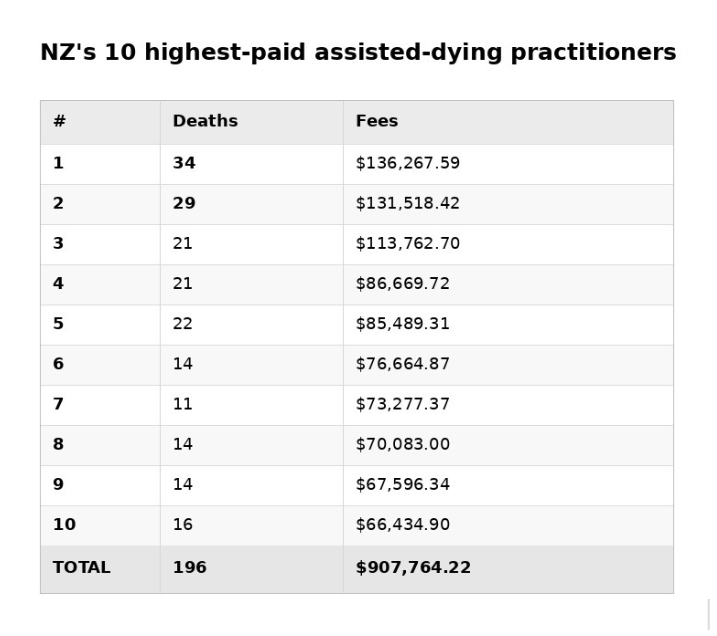
And here at home, Official Information Act results requested by Right To Life NZ have just revealed New Zealand’s highest-volume practitioner for 2025 has a body count of 34 in that year alone.
We don’t know who this doctor is. But we do know they earned $136,267.59 for their assisted dying services in just one year.

Dr Katie Ben - 20 deaths, 100+ assessments
We do know Dr Katie Ben, a Nelson anaesthetist and assisted-dying practitioner, has assessed more than 100 patients and provided more than 20 assisted deaths since joining the service. She conducts both first and second assessments and has learned to fly, using her own plane to travel across the South Island to deliver death in more remote areas. Travel associated with providing assisted-dying services is reimbursed by the publicly funded Assisted Dying Service.
Ben is also National President of the Association of Salaried Medical Specialists and has served as Lead Clinical Advisor to the Assisted Dying Board Secretariat. She speaks at assisted-dying conferences and events and has submitted recommendations for changes to New Zealand’s assisted-dying legislation.
Dr Gary Payinda - hundreds of patients
And Dr Gary Payinda, a Whangārei emergency physician and assisted-dying practitioner, says he has “worked with hundreds of patients” through New Zealand’s assisted-dying system. A prominent advocate for legalisation before the law was passed, he now provides assisted-dying services on his days off and continues to advocate for expanding eligibility, while speaking publicly about the practice.
These aren't doctors who have reluctantly crossed an extraordinary ethical boundary once. Some have built a substantial part of their professional lives around assisted death.
These doctors write books about it. They teach it. They develop protocols for it. They establish professional organisations around it. They even sit on review boards to provide checks on work in the field. They refine the drugs used to produce death, advise other doctors how to do it and publicly describe the experience as rewarding, intimate, liberating, compassionate and among the most meaningful medicine they practise.
Canada's own government has acknowledged the development of “focused expertise” in assisted dying, as a small group of doctors carry out a remarkable proportion of the country's assisted deaths.
New Zealand is showing early signs of the same phenomenon.
During the year to March 2026, just ten practitioners accounted for 196 assisted deaths. Together those ten practitioners received more than $907,000 in assisted-dying fees, excluding travel payments.
Thirty-four people intentionally brought to death by one medical practitioner in one year. That’s almost three every month.
It raises an uncomfortable question that gets remarkably little attention in discussions about euthanasia: What kind of doctor becomes a specialist in killing?
Perhaps more importantly, what happens psychologically when ending lives becomes not an extraordinary act, but a repeated, skilled and personally rewarding form of medical work?
A growing body of research provides a disturbing answer. The doctors doing this work don't necessarily become cold…Some appear to experience exactly the opposite.
They describe killing as compassion and care. They describe experiencing enormous gratitude from patients and families. They describe satisfaction, intimacy, liberation and professional meaning.
Some become convinced that providing death makes them better doctors — even better human beings.
This phenomenon has even provoked research into asking whether some motivations and rationalisations found among assisted-dying practitioners resemble those previously documented among healthcare serial killers.
Not because legal euthanasia doctors are serial killers… But because some serial killers working in medicine did not understand themselves primarily as monsters either.
Some believed they were helping.
When assisted dying produces specialists
Assisted dying is normally presented through the story of an individual patient…A person develops terminal cancer, feels overwhelmed by their suffering, and looks for a way to exit their struggle.
But once assisted dying becomes established within a healthcare system, something else begins to happen - someone has to provide it.
And what we see is a worldwide trend: Many doctors refuse.
Others support assisted dying politically but do not want to personally administer lethal drugs; some participate once or twice but find the experience emotionally difficult.
And in the end a smaller group of willing practitioners can consequently receive more referrals. Repeated provision builds experience and, potentially, specialised expertise.
And eventually, the exceptional procedure begins producing something that would once have sounded almost absurd: specialists in medically causing death.
Canada provides perhaps the clearest example:
In 2024, 16,499 Canadians died through MAiD, provided by 2,266 practitioners.
But the work was heavily concentrated: just 102 practitioners — 4.5 per cent of MAiD providers — carried out 37.5 per cent of all assisted deaths in Canada that year.
Health Canada had already described this concentration as MAiD becoming an area of “focused expertise” for some practitioners.
New Zealand shows signs of concentration too.
In 2022/23, there were 148 practitioners listed with SCENZ and 328 assisted deaths occured. By 14 May 2026, the SCENZ lists contained 121 practitioners — down 18 per cent — while the number of assisted deaths during the year to 31 March 2026 had risen to 486, up 48 per cent from 2022/23.
Information obtained through an Official Information Act inquiry by Right to Life NZ reveals payment data providing a closer look at repeat provision: the 10 practitioners associated with the highest assisted-dying payments were involved in 196 deaths, receiving $907,764 in combined fees. The highest-volume practitioner was associated with 34 deaths.
This process is visible at an individual level too.
Ellen Wiebe has reportedly provided around 430 assisted deaths and has worked extensively in women's health and MAiD.
Stefanie Green moved into assisted-dying work immediately after Canada's law changed and eventually began working almost exclusively in the field. Becoming the founding president of the Canadian Association of MAiD Assessors and Providers, an adviser and educator, and the author of a book describing the practice, she has publicly stated her involvement in at least 300 assisted deaths.
Dr Lonny Shavelson has evaluated more than 1,000 people considering assisted death and attended more than 200 deaths in California, while helping establish professional training around the practice.
The research that asks an extraordinary question
In August 2024, researcher Christopher Lyon published online in the peer-reviewed journal HEC Forum with a title that would have been almost unthinkable in mainstream medical literature only a decade earlier: “Canada's Medical Assistance in Dying System Can Enable Healthcare Serial Killing.”
Lyon examines Canada's MAiD system through what is known about healthcare serial killing to determine whether safeguards designed for legal euthanasia would also detect a clinician who entered or exploited the system for criminal purposes.
His conclusion is very uncomfortable.
Healthcare serial killers frequently target the same kinds of patients likely to qualify for assisted dying: people who are seriously ill, dependent, elderly, vulnerable or expected to die.
Such deaths can be difficult to distinguish from natural deterioration; the practitioner is trusted, the killing occurs within healthcare, oversight may be fragmented, and the death may initially attract little suspicion precisely because the patient was already sick.
Lyon argues that those structural similarities matter because healthcare serial killers have historically been extraordinarily difficult to identify.
Cases involving Harold Shipman, nurse Elizabeth Wettlaufer, and Charles Cullen revealed repeated failures by healthcare organisations to collate warning signs, respond to complaints or recognise unusual patterns of death.
The disturbing question is therefore not merely whether existing assisted-dying practitioners are behaving properly. It is whether a system built around legally allowing clinicians to intentionally cause death could reliably identify the clinician who wasn't.
But the comparison goes much further than safeguards
The most provocative part of Lyon's research concerns motivation.
Healthcare serial killers are not psychologically identical; they have a variety of motivations, from the thrill of excitement to attention or a sense of power. But one comparison Lyon explores involves the ‘mercy-hero’ healthcare serial killer: someone who kills patients while believing, or claiming to believe, that they are rescuing them from suffering.
In the healthcare-serial-killer literature, the motivation can arise from what researchers describe as misplaced or pathological compassion rather than obvious sadism.
That distinction is enormously important. Some healthcare killers believed suffering justified death, and they appointed themselves the person who would end it.
Lyon describes this as potentially overlapping with pathological altruism — harm caused through a conviction that one is helping. His paper then makes the controversial observation that assisted-dying providers frequently describe their work using remarkably similar moral concepts: “Care”, “love”, “compassion”, “relief of suffering”, “help”.
The study explicitly says that this does not mean a doctor who provides assisted dying out of compassion is therefore a serial killer — consent, legality and eligibility are profound differences. But the psychological comparison should not simply be waved away because it makes people uncomfortable.
The possibility raised here is not simply emotional numbness, but moral reinforcement: repetition occurring within a framework in which the act is understood as compassionate.
NZ’s Gary Payinda: “Purely because I believe in it”
Dr Gary Payinda is one of New Zealand's clearest examples of an experienced assisted-dying practitioner who speaks about his involvement not as reluctant medical duty but as a matter of deeply held personal conviction.
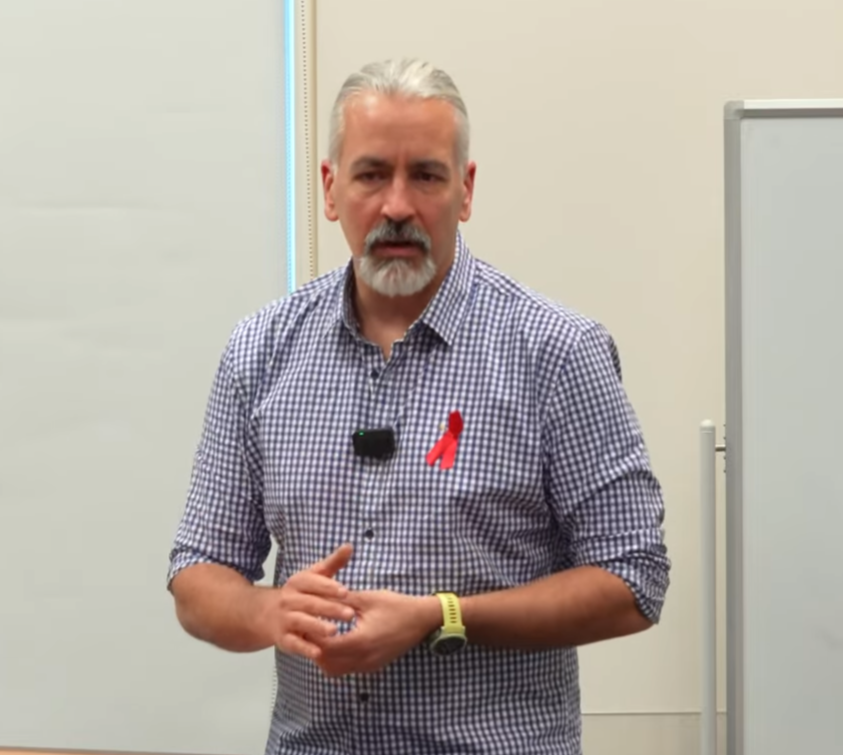
Dr Gary Payinda speaking during Dying Matters Week Aotearoa 2025. Screenshot: Go With Grace/YouTube.
Speaking at a public meeting, Payinda said he had “worked with hundreds of patients” through New Zealand's assisted-dying system.
An emergency physician whose ordinary work frequently involves preventing death, Payinda acknowledges the apparent contradiction. Yet he describes helping a suffering person to die as “one of the nicest things you can do.” He undertakes assisted-dying work on his days off, sometimes travelling significant distances to reach patients.
His explanation is simple: “Purely because I believe in it.”
His reasoning is personal. If he were dying painfully and wanted somebody to help him die, he says he would want a doctor willing to provide that option, so he believes he must be prepared to do the same. “I can't be a hypocrite.”
Payinda has also described working with dying people as making him “a more grounded practitioner and a better human being.”
His comments provide an important insight into the psychology of repeat assisted-dying practice. Payinda does not describe the work merely as something the law permits; he presents it as compassionate, personally meaningful and consistent with his values.
This is an extraordinarily important insight into the psychology of repeat assisted-dying practice.
That framing is also relevant to how he views the law’s safeguards. Payinda has repeatedly described aspects of the End of Life Choice Act as “hoops and hurdles” and criticised bureaucracy and delays.
From his perspective, safeguards become obstacles preventing the doctor from doing good, institutions refusing euthanasia become institutions denying care, a colleague’s conscientious objection becomes abandonment of the patient, and exclusion from eligibility makes the patient a victim of an unjust law.
His position also illustrates how support for expanding assisted-dying laws can come from experienced practitioners within the system itself.
That should make us extraordinarily cautious about who society empowers to repeatedly make life-and-death judgements.
The point is not that these emotions have identical origins. It is that positive emotions and a sense of moral fulfilment can accompany repeated participation in assisted dying. Once that is acknowledged, the psychology and caseloads of high-volume practitioners warrant closer scrutiny.
“The worrying part is when it just becomes normal”
A senior New Zealand palliative-care doctor interviewed by Voice For Life described her concern succinctly: “The worrying part is when it just becomes normal.”
She has watched clinicians adapt to assisted dying while some hospice workers experience significant moral distress around the practice. For Payinda, however, the experience is markedly different. He describes the work as fulfilling.
What one doctor sees as normalisation, another sees as improvement. This is the philosophical divide at the heart of Lyon’s research.
His argument is not that every high-volume assisted-dying provider should be suspected of criminality. But once medicine permits doctors to intentionally cause death, safeguards must do more than regulate eligibility and consent. They must also be capable of detecting the rare but catastrophic possibility of a dangerous clinician — including someone deliberately exploiting medical authority to kill.
And that leaves perhaps the most difficult question raised by the research.
The danger is not only the doctor who becomes comfortable with killing because they have lost their compassion. It may also be the doctor who becomes comfortable with killing because they believe they are acting in the name of compassion.
Research from the University of Auckland provides an important insight into this possibility. In the 2025 study, Early experiences of the End of Life Choice Act 2019 amongst assisted dying practitioners in Aotearoa New Zealand, researchers interviewed 22 assisted-dying practitioners about their experiences during the first year of New Zealand's law.
Far from describing themselves as becoming detached or indifferent, practitioners consistently described providing assisted dying as a “privilege”. Patients' final expressions of gratitude reinforced the belief that they were relieving suffering, honouring autonomy and helping people achieve the deaths they wanted.
The researchers describe practitioners as undertaking this work “driven by compassion rather than compensation.”
It suggests that repeated participation in assisted dying does not necessarily require a doctor to suppress their sense of compassion. The opposite may occur: intentionally ending a patient's life can become incorporated into the doctor's understanding of what compassionate medicine itself requires.
In the name of compassion
Perhaps the most important finding running through this research is also the most uncomfortable: a doctor can become extensively involved in intentionally ending human life while experiencing that work as compassionate, morally good and personally affirming.
That is precisely why the psychology matters.
Lyon’s research does not establish that high-volume assisted-dying practitioners are healthcare serial killers, nor should they be treated as such. Consent, legality and eligibility are fundamental differences. His research instead forces attention onto what happens when medicine accepts a proposition that changes the moral meaning of causing death: deliberately killing a suffering patient can be an act of compassion.
Once that proposition enters medicine, the psychological barrier to repeatedly causing death changes fundamentally. Ending life can be understood as relieving suffering; repetition can produce experience and expertise; gratitude can reinforce the practitioner’s conviction; and causing death can be experienced not as a violation of medical purpose, but as meaningful and compassionate work. Published accounts cited in Lyon’s research include practitioners describing assisted dying as “loving”, “heartwarming”, “rewarding” and an “ultimate act of compassion”.
Scrutiny is essential.
A system that authorises clinicians to intentionally cause death must be capable of examining provider caseloads, complaints, unusual patterns and behaviour, and of distinguishing lawful compassionate practice from the clinician whose motivations or judgement may be dangerous.
The history of healthcare serial killing makes that distinction especially important because dangerous behaviour has not always been accompanied by obvious cruelty. Some killers have understood or presented their actions as mercy — as ending suffering rather than causing harm.
And that leaves the most unsettling possibility raised by the research.
Perhaps the greatest danger is not the doctor who develops a euthanasia body count after losing all sense of compassion. It is the doctor who develops one in the name of compassion.
*Nothing in this article alleges that these assisted-dying practitioners are serial killers, have murdered their patients or have acted outside the law. The comparison examined here is the narrower one raised in published research: whether some structural features, motivations and psychological patterns associated with healthcare serial killing can also appear within legal assisted-dying practice.
References:
*Parliament of Canada, Special Joint Committee on Medical Assistance in Dying, testimony of Dr Ellen Wiebe, 2022.
*Toronto Star. (2025, December 13). Should MAiD be extended to include those with mental illness? Debate between Dr Ellen Wiebe and Dr John Maher.
*Subramanya, R. (2026, January 26). Determined to Die. The Free Press.
*Aviv, R. (2025, August 11). Canada Gave Citizens the Right to Die. Doctors Are Struggling to Keep Up. The Atlantic.
*Green, S. (2024, November 11). Evidence to the Health, Social Care and Sport Committee, Assisted Dying for Terminally Ill Adults (Scotland) Bill: Stage 1. Scottish Parliament.
*BBC World Service. (2023, February 20). Stefanie Green: The ethics of assisted dying. HARDtalk.
*Cal Alumni Association. (2021). The Edge, Episode 11: A Completed Life. Interview with Dr Lonny Shavelson, University of California, Berkeley.
*Calver, M. (2024, October 29). Quebec's legalization of advance MAID requests raises legal, medical concerns. Canadian Affairs.
*Calabro, E. P. (2025, August 11). Canada Gave Citizens the Right to Die. Doctors Are Struggling to Keep Up. The Atlantic.
*Lacoursière, A., & Cousineau, M.-E. (2026, April 5). Québec: Des médecins «superprestataires» d'AMM. La Presse.
*Cindy E. Harnett, “Doctor of MAiD: New memoir tells story of Island pioneer in assisted dying,” Times Colonist, 27 March 2022.
*Ian Birrell, interview with Dr Marc Van Hoey, originally published in the Mail on Sunday, December 2018.
*Lonny Shavelson MD, American Clinicians Academy on Medical Aid in Dying, clinical guidance, 2025.
*Health New Zealand | Te Whatu Ora. (2026). Official Information Act response: assisted-dying practitioner payments and number of assisted deaths, 1 April 2025–31 March 2026. Information obtained by Right to Life New Zealand.
*Radio New Zealand. (2025, February 24). Assisted dying: A situation report.
*Radio New Zealand. (2024, August 2). End of Life Choice: How difficult decisions are made.
*Health New Zealand | Te Whatu Ora. (2026). Assisted dying service funding and payments.
*Payinda, G. (2025). Assisted Dying Talk. Dying Matters Week Aotearoa, Go With Grace NZ.
*Radio New Zealand. (2019, June 14). Supporters of euthanasia legislation confront Whangārei National MP.
*Dehkhoda, A., Frey, R., Carey, M., Robinson, J., Sundram, F., Hoeh, N., Bull, S., & Cheung, G. (2025). Early experiences of the End of Life Choice Act 2019 amongst assisted dying practitioners in Aotearoa New Zealand. BMC Palliative Care, 24, Article 149.
*Lyon, Christopher. “Canada’s Medical Assistance in Dying System can Enable Healthcare Serial Killing.” HEC Forum 37(1), 65–105. Published online 2 August 2024. DOI: 10.1007/s10730-024-09528-3